


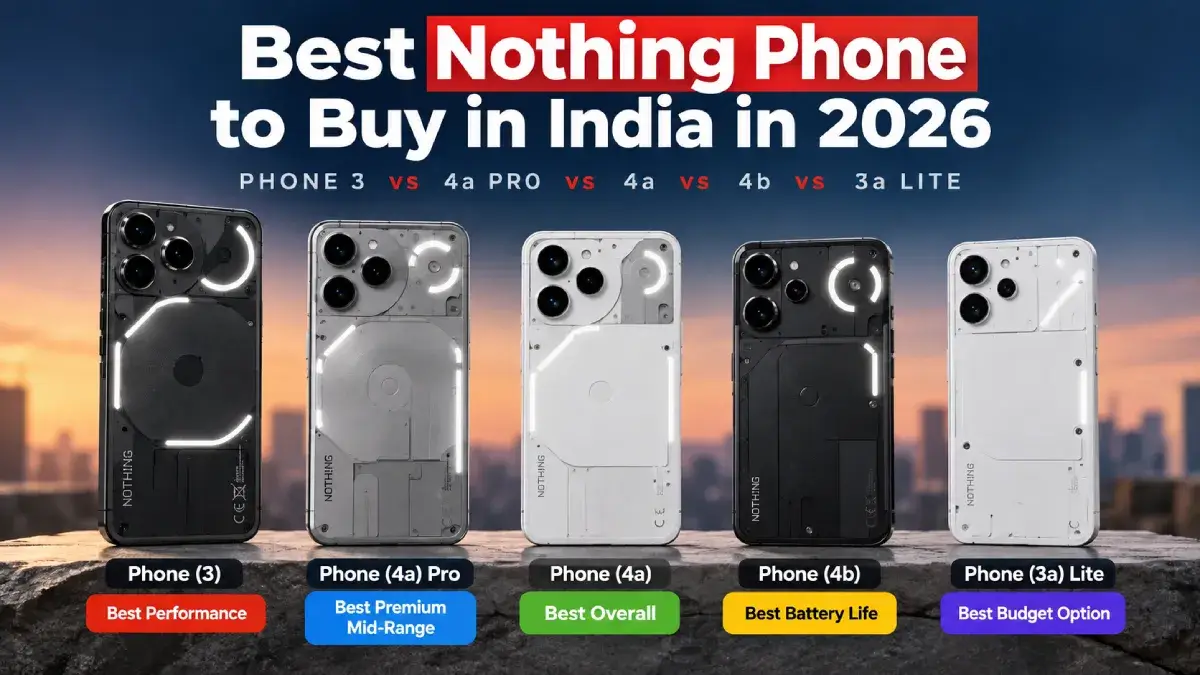
Choosing the best Nothing phone in India in 2026 depends on what you value most: performance, cameras, battery life, design or price. The lineup includes five phones with noticeably different strengths, so buying the most expensive model is not automatically the smartest decision.
For most people, the Nothing Phone (4a) is the best all-rounder. It combines a sharp 120Hz AMOLED display, a versatile camera system with 3.5× optical zoom, a 5,400mAh battery and fast charging. If gaming performance and long-term hardware capability matter more, the Nothing Phone (3) deserves serious consideration. The Phone (4a) Pro is the premium mid-range alternative, while the Phone (4b) prioritises battery life and the Phone (3a) Lite targets buyers who want the Nothing experience at a lower cost.
Quick comparison: Which Nothing phone is best?
| Phone | Best for | Main advantage | Main compromise |
|---|---|---|---|
| Nothing Phone (3) | Performance enthusiasts | Fastest processor, premium build and wireless charging | Higher price; can heat up under sustained heavy loads |
| Nothing Phone (4a) Pro | Premium mid-range buyers | 144Hz display, metal body and periscope camera | More expensive than the standard 4a |
| Nothing Phone (4a) | Most people | Strong balance of display, cameras and battery | No wireless charging; weaker water protection than Phone 3 |
| Nothing Phone (4b) | Battery-focused users | 6,000mAh battery | Slower processor and no telephoto camera |
| Nothing Phone (3a) Lite | Budget-conscious buyers | AMOLED display and distinctive design | Simpler cameras, slower charging and fewer premium features |
The comparison is based on the supplied research and available Indian listings. Prices vary by seller, configuration and offer.
1. Nothing Phone (4a): Best Nothing phone for most people
The Nothing Phone (4a) is the most balanced choice in this lineup. It offers features that make a practical difference in everyday use without requiring buyers to pay for the Pro model or the more powerful Phone 3.
Its 6.78-inch 1.5K AMOLED display supports a 120Hz adaptive refresh rate. Scrolling feels smooth, text looks sharp, and the screen is well suited to watching videos, browsing social media and playing games.
The camera system is another major reason to consider this phone. Alongside its 50MP main camera, it has a dedicated 50MP periscope telephoto camera with 3.5× optical zoom and an 8MP ultrawide camera. That gives it more photographic flexibility than phones that rely entirely on their main camera and digital zoom.
The Snapdragon 7s Gen 4 processor is suitable for everyday multitasking, social media, video streaming and casual gaming. Its 5,400mAh battery and 50W wired charging complete a well-rounded package.
Why buy it?
- You want a good display without paying flagship prices.
- You take portraits and zoom photographs regularly.
- You want dependable everyday performance and battery life.
- You prefer Nothing OS and its distinctive design.
What to consider: The phone lacks wireless charging and has an IP64 rating. Its ultrawide camera is less impressive than its main and telephoto cameras, and NFC availability should be checked for the Indian variant before purchase.
Verdict: The Phone (4a) is the safest recommendation for buyers who want a well-balanced Nothing phone rather than a device built around one standout feature.
2. Nothing Phone (3): Best for performance and premium features
The Nothing Phone (3) is the stronger option for users who prioritise processing power, gaming and premium hardware.
It uses the Snapdragon 8s Gen 4 processor, paired with LPDDR5X memory and UFS 4.0 storage. Compared with the mid-range chipsets in the 4a series, this gives it a substantial advantage for demanding applications, intensive multitasking and heavier games.
Its camera system includes three 50MP rear cameras: a main camera, a telephoto camera with 3× optical zoom and an ultrawide camera. It also has a 50MP front camera. The combination offers more flexibility than a basic dual-camera setup.
Other advantages include a 6.67-inch 120Hz AMOLED display, IP68 water and dust resistance, 65W wired charging, 15W wireless charging and the Glyph Matrix rear interface.
The important question is price. The phone originally launched at ₹79,999, but its Indian street price has fallen considerably. A recent price listing showed approximately ₹51,999, although the actual offer and configuration can differ. This makes it more competitive than it was at launch.
Why buy it?
- You play demanding games or use resource-intensive apps.
- You want premium build quality and IP68 protection.
- Wireless charging matters to you.
- You plan to keep the phone for several years and value its stronger hardware.
What to consider: The phone can heat up during prolonged heavy workloads. It also has a 120Hz display rather than the 144Hz panel on the 4a Pro, and it costs more than the standard 4a.
Verdict: Choose the Phone (3) if performance and premium features justify the extra cost. Compare its current price against the 4a Pro before deciding.
3. Nothing Phone (4a) Pro: Best for display, design and zoom photography
The Nothing Phone (4a) Pro occupies the space between the standard 4a and the more performance-oriented Phone (3).
Its 6.83-inch 1.5K AMOLED display supports an adaptive refresh rate of up to 144Hz. That higher refresh rate can make scrolling and supported games feel smoother, although the improvement over 120Hz is less important than the overall display quality and performance.
The phone uses the Snapdragon 7 Gen 4 processor, LPDDR5X memory and UFS 3.1 storage. Its aluminium unibody gives it a more premium feel than the standard 4a.
For photography, it combines a 50MP main camera with a 50MP periscope telephoto camera offering 3.5× optical zoom and an 8MP ultrawide camera. The advertised 140× zoom is digital and computational, not 140× optical zoom. For consistently useful photographs, the dedicated optical zoom range matters far more than the maximum marketing number.
The 5,400mAh battery and 50W charging make it a capable everyday phone, while its Glyph Matrix gives it the more sophisticated rear notification interface associated with Nothing's premium models.
Why buy it?
- You want a large, high-refresh-rate display.
- You value a metal chassis and distinctive design.
- You regularly photograph distant subjects, portraits or architectural details.
- You want premium mid-range hardware without moving to a more expensive flagship category.
What to consider: It lacks wireless charging, has IP65 protection rather than the Phone 3's IP68 rating, and offers less processing power than the Phone 3. Its 8MP ultrawide camera is also less impressive than the main and telephoto cameras.
Verdict: The 4a Pro makes sense when the display, construction and camera experience matter more to you than maximum processing power.
4. Nothing Phone (4b): Best for battery life
The Nothing Phone (4b) follows a different philosophy. Instead of competing with the more expensive models on camera versatility or raw performance, it focuses on battery capacity and everyday essentials.
Its 6,000mAh battery is the largest in this comparison. For people who spend long hours away from a charger, travel frequently or simply dislike charging their phones every night, that is an attractive advantage.
The phone has a 6.77-inch FHD+ AMOLED display with a 120Hz refresh rate, a Snapdragon 6 Gen 4 processor, a 50MP main camera with optical image stabilisation and an 8MP ultrawide camera. It also includes stereo speakers and a simplified Glyph interface.
The compromises are straightforward: the display has a lower resolution than those of the 4a and 4a Pro, charging is limited to 33W, and there is no dedicated telephoto camera.
Why buy it?
- Battery capacity is your top priority.
- Your typical use consists of calls, messaging, navigation, video and light gaming.
- You want Nothing's design and software experience at a lower price than the 4a series.
What to consider: Buyers who play demanding games or frequently take zoom photographs will get more from the Phone (3) or Phone (4a).
Verdict: The Phone (4b) is a sensible battery-first choice, not the best choice for users who want maximum performance or camera flexibility.
5. Nothing Phone (3a) Lite: Best for buyers on a tighter budget
The Nothing Phone (3a) Lite brings the brand's distinctive styling and software experience to a more affordable segment.
Its specifications include a 6.77-inch FHD+ AMOLED display with a 120Hz refresh rate, a MediaTek Dimensity 7300 Pro processor, a 5,000mAh battery and 33W charging. Its rear cameras comprise a 50MP main camera, an 8MP ultrawide camera and a 2MP macro camera.
The display is a strength for the price, and the processor is adequate for everyday tasks. However, the camera setup is less versatile than the telephoto-equipped 4a models. Charging is slower, the Glyph system is simpler, and the phone lacks the stereo-speaker experience and premium construction of the higher-end models.
Price is particularly important here. A phone that made sense at its launch price can become less attractive when it approaches the cost of a more capable model. Compare the actual selling price of the Lite with the standard 4a, older discounted models and competing phones before purchasing.
Why buy it?
- You want the Nothing design and software at a lower entry price.
- Your use is mainly messaging, browsing, streaming and light gaming.
- You do not need a dedicated zoom camera or premium materials.
Verdict: Buy the 3a Lite when affordability is the deciding factor and the price difference is meaningful. Otherwise, the more capable alternatives may provide better long-term value.
Which Nothing phone offers the best value?
Value depends on the price you actually pay, not just the original launch price.
The Phone (4a) is the balanced choice because it combines a capable processor, a good display, a versatile camera system and a large battery. The Phone (3) becomes particularly attractive when discounts bring it close to the upper-mid-range models, because it offers substantially more processing power, IP68 protection and wireless charging.
The 4a Pro is worth paying extra for if you appreciate its larger 144Hz display, metal construction and more premium camera system. The 4b serves buyers who prioritise battery capacity, while the 3a Lite is best reserved for tighter budgets.
Before buying, compare the exact RAM and storage variant, the final price after offers, warranty coverage and regional features such as NFC. These details can change which model is the better deal.
Final verdict: Which Nothing phone should you buy in 2026?
- Best for most people: Nothing Phone (4a)
- Best for performance and premium features: Nothing Phone (3)
- Best premium mid-range experience: Nothing Phone (4a) Pro
- Best battery-focused choice: Nothing Phone (4b)
- Best entry-level option: Nothing Phone (3a) Lite
If I had to recommend just one phone to the average buyer, I would choose the Nothing Phone (4a). Its combination of display quality, camera versatility, battery capacity and everyday performance makes it the most balanced option.
However, if the Phone (3) is available at a competitive discount and your budget allows it, compare the two carefully. The Phone (3) is the better choice for demanding workloads and premium features, while the 4a is the more straightforward all-rounder.
The smartest purchase is not necessarily the most expensive Nothing phone. It is the model whose advantages you will actually use every day.

